DeepSeek, the Chinese AI lab whose R1 model triggered a $593 billion one-day drop in Nvidia’s market capitalization in January 2025, is in talks to raise at least $300 million at a valuation above $10 billion, The Information reported today, with Reuters and others confirming the outlines. It would be DeepSeek’s first outside fundraising round. Until now the lab has been backed entirely by its parent company, High-Flyer Capital Management, a quantitative hedge fund that posted roughly 56.6 percent returns in 2025. DeepSeek has previously turned down multiple offers from China’s leading venture capital firms and major domestic tech companies.
The stated rationale for opening the door now is straightforward: demand for DeepSeek’s models and API services has outrun its infrastructure, and the company needs capital to expand GPU capacity, stabilize services, and continue commercializing. The more interesting questions are about the shape of the round, rather than the fact of it.
The business case for backing an open-weights lab
DeepSeek publishes its model weights, including for its flagship R1 reasoning model and the V3 and V4 model families, under MIT and other permissive licenses. Any developer or company can download the weights and run inference on their own hardware. What DeepSeek does not open-source is its training data, its training pipeline, or its hosted inference stack. Revenue comes from a managed API business that undercuts OpenAI and Anthropic on price, and from what the company describes internally as commercialization: enterprise deployments, custom integrations, and hosted services built on top of the open weights.
The commercial logic resembles Mistral’s, which has run a parallel strategy in Europe. Open weights drive adoption and lower the effective cost of model serving for the industry; a competitively priced API captures the customers who would rather pay to avoid operating their own inference at scale. The catch for investors is that because the weights are free, any third party can stand up a rival inference service on the same model. Several hyperscalers already do, which caps DeepSeek’s pricing power. A $10 billion valuation is therefore partly an API-business bet and partly a strategic bet, that a China-headquartered frontier lab with broad weight distribution will be strategically important enough to sustain that valuation whether or not the API achieves Western-scale margins.
Who is actually in the round
Domestic Chinese investors are overwhelmingly the expected participants. No U.S. venture firm has been publicly linked to the round, and industry coverage is explicit that U.S. capital faces “regulatory pressure and national security concerns that could limit involvement.” Two specific constraints apply. The U.S. Treasury’s outbound investment rules, implemented through 2024 and 2025, require notification or outright prohibition on U.S. money flowing into Chinese AI, advanced-semiconductor, and quantum companies at the frontier, which would clearly cover DeepSeek. Beyond the rules, the Pentagon’s recent posture toward Anthropic and OpenAI has made it politically costly for U.S. firms to take positions that could be read as supporting Chinese frontier-AI development.
That DeepSeek has also historically rejected approaches from leading Chinese venture firms and major domestic tech companies is its own signal. Founder Liang Wenfeng has talked publicly about wanting DeepSeek to remain independent of the Chinese platform companies. The fact that the lab is raising at all suggests capital demands for the reasoning and agentic model generation have outgrown what High-Flyer returns can cover. That it is raising only from domestic capital suggests Beijing’s informal preferences, documented in its intervention in the Manus acquisition last month, are shaping the round as much as the lab’s own choices.
The bifurcation is the story
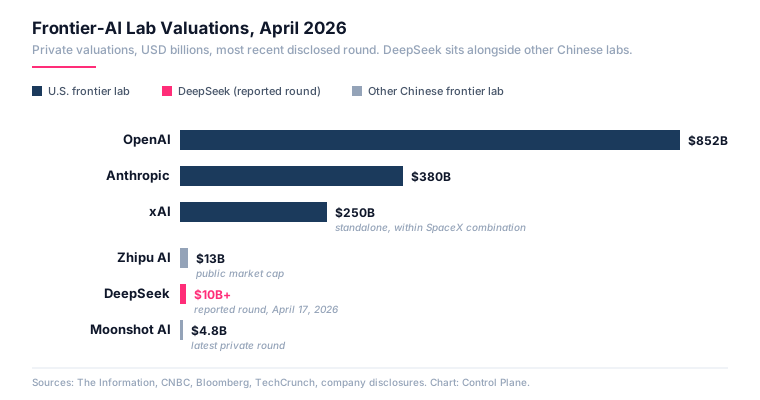
Take the last eighteen months of frontier-AI capital activity together. Anthropic raised from U.S. and allied investors at a reported $175 billion valuation earlier this year. OpenAI is valued at around $500 billion after its latest secondary. Mistral has raised from a mix of European, Middle Eastern, and U.S. sources. xAI has pulled together multi-billion-dollar rounds from U.S. and Gulf investors. On the other side of the line, Zhipu, Moonshot, and Baichuan raised primarily from Chinese state-adjacent and tech-company investors over 2024 and 2025. What DeepSeek’s round confirms is that the last holdout lab, the one that had tried to stay independent of both sides, is raising inside the Chinese capital system and not outside it.
A year ago, a U.S. or allied firm investing in a Chinese frontier lab was awkward but imaginable. Today, at the frontier, it is not happening in either direction. The frontier-AI capital market has bifurcated along national-security lines, and the DeepSeek round is the first named raise to sit cleanly inside the new structure.
Three implications follow. The cost-of-frontier data point is the first. DeepSeek has spent eighteen months being cited as proof that the frontier could be reached cheaply; R1 was reportedly trained for around six million dollars. The fact that the lab now needs $300 million of outside capital to keep up says that the reasoning and agentic model generation is expensive enough that even the most cost-advantaged lab in the world cannot bootstrap the next cycle off hedge-fund returns. That is a useful benchmark for anyone trying to size the compute and capital requirements of the 2026 and 2027 model generations.
The open-weights distribution channel is the second. Every dollar DeepSeek spends training a new model ends up, on current patterns, as freely-distributed weights available globally. A funded DeepSeek with $300 million of fresh capacity to put behind V4 and its successors makes a Mythos-class open-weights release a firmer prediction, not a softer one. Those weights will be subject to whatever oversight the Chinese state can exert over the lab, which the Manus episode suggests is more than nothing, and which the Communist Party has documented preferences about.
The strategic small-cap valuation is the third. $10 billion is a rounding error against Anthropic or OpenAI. It is also exactly the right number for a lab whose customer base is primarily inside China and whose strategic role is to ensure Beijing has a credible, indigenous, globally distributed frontier-AI option. DeepSeek at $10 billion is not trying to win a Western-scale commercial race. It is trying to ensure that China stays within a few months of the leading edge, with weights everyone can download, regardless of what happens to export controls, Taiwan, or U.S.-China capital flows.
Whether DeepSeek raises at $10 billion or higher, and exactly which Chinese investors end up in the cap table, will fill in the details. The structural story is already settled. Frontier AI no longer has a single capital market, it has two, and the DeepSeek round is the first time the boundary between them has been this visible on a marquee deal.
Sources: The Information (original reporting), Reuters via Investing.com, Tech Startups, CoinCentral, Quartz
–
By the Control Plane Editorial Team