Three model releases in 72 hours point to an accelerating shift in the AI infrastructure stack: increasingly capable models are becoming viable outside the data center, running locally on consumer hardware at low cost.
Data centers are not going away. The largest frontier models still require massive compute clusters to train and serve, and that is unlikely to change in the near term. But a second tier of models is developing rapidly, one capable enough for a growing range of production use cases and small enough to run on a phone, a laptop, or an edge device without a cloud dependency.
Three Releases, One Direction
On March 31, PrismML emerged from stealth with Bonsai 8B, a true 1-bit large language model that fits into 1.15 gigabytes of memory. That is approximately 14 times smaller than a standard 16-bit model of the same parameter count. The company, founded on Caltech research, claims the model performs competitively on standard benchmarks while maintaining the instruction-following and multi-step reasoning capabilities that have historically degraded in aggressive compression schemes. PrismML frames this not as a quantization tradeoff but as a distinct architectural regime, measuring performance in terms of “intelligence density” rather than raw benchmark scores.
Today, Google DeepMind released Gemma 4, a family of four open models ranging from an effective 2 billion parameter edge model to a 31 billion parameter dense model, all under the Apache 2.0 license. The smallest configurations are designed to run on phones and Raspberry Pi hardware. Google describes the family as built for “complex logic and agentic workflows” rather than simple chat, and the edge variants carry a 128,000-token context window. The company says the models outperform others 20 times their size.
Also today, Alibaba released Qwen3.6-Plus, the latest model in its flagship series. The release centers on agentic coding and multimodal reasoning, with a 1 million-token context window and explicit positioning for autonomous, multi-step enterprise workflows. The model is being integrated into Alibaba’s Wukong enterprise AI platform, which automates complex business tasks using multiple agents operating in sequence.
| Model | Developer | Size on disk | Context window | License | Target deployment |
|---|---|---|---|---|---|
| Bonsai 8B | PrismML | 1.15 GB | Not disclosed | Commercial | Phone, laptop, edge |
| Gemma 4 E2B | Google DeepMind | ~1–2 GB | 128K tokens | Apache 2.0 | Phone, Raspberry Pi |
| Gemma 4 31B Dense | Google DeepMind | ~20 GB | 256K tokens | Apache 2.0 | On-premise server |
| Qwen3.6-Plus | Alibaba | Not disclosed | 1M tokens | Not disclosed | Enterprise, cloud |
The Agentic Shift
What is notable about this week’s releases is the explicit targeting of agentic use cases, not just inference on static inputs. Gemma 4 and Qwen3.6-Plus are both described as purpose-built for autonomous multi-step workflows. PrismML’s architecture makes the same claim at a radically smaller footprint. The on-device model conversation has historically been about convenience and latency. It is increasingly about capability.
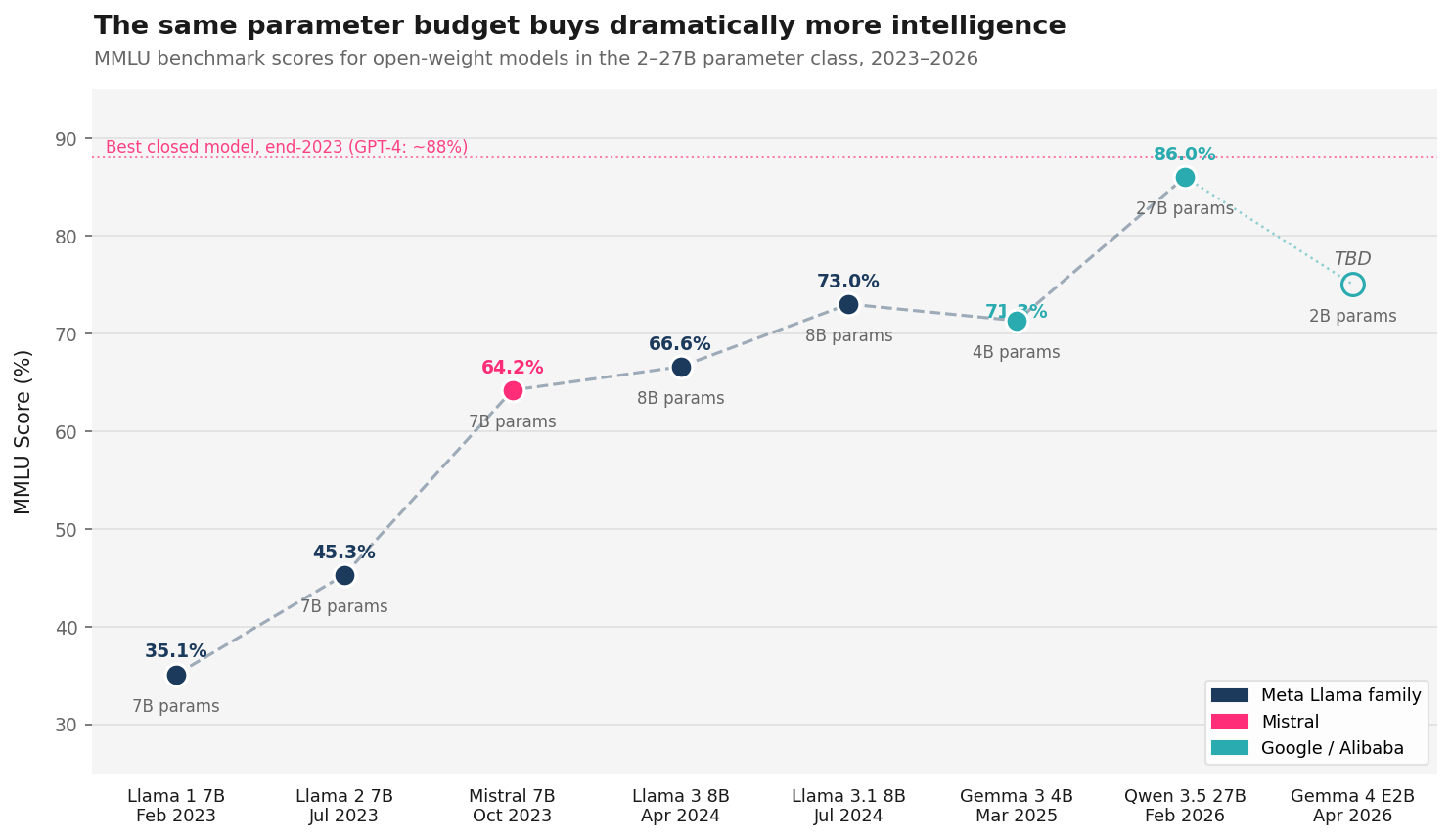
The trajectory of open-weight model capability makes this shift more significant than any single release. In early 2023, the best open-weight 7B model scored around 35 percent on MMLU, a standard knowledge and reasoning benchmark, while the best closed model scored roughly 88 percent. By mid-2026, open-weight models in the same parameter class routinely exceed 70 percent, and models in the 27B range are approaching 86 percent on the same tests. That gap has narrowed from 53 percentage points to under five in three years. As capable models become smaller and cheaper to run, the barrier to deploying autonomous agents at the edge falls with them. The same efficiency gains that make on-device intelligence more accessible to legitimate enterprise use cases also lower the bar for adversarial deployments: phishing agents, automated social engineering, and credential-harvesting workflows that require no cloud infrastructure and leave no API trace.
What This Means for Infrastructure and Security
The security implications are not straightforward. Capable AI running locally reduces certain attack surfaces, particularly those created by API calls passing sensitive data through third-party infrastructure. It also removes some visibility that centralized deployments provide. An agentic workflow operating entirely on-device is harder for an organization to monitor, audit, or shut down than one running through a managed cloud endpoint.
For enterprises making infrastructure decisions now, the edge model question is no longer theoretical. The models exist, the hardware to run them is widely available, and at least three major organizations shipped significant updates in the same 72-hour window. The strategic question is what this shift does to deployment architecture, and whether the security frameworks being built around centralized inference can adapt as intelligence moves closer to the edge.
Sources: PrismML, Google DeepMind, Alibaba
–
By the Control Plane Editorial Team