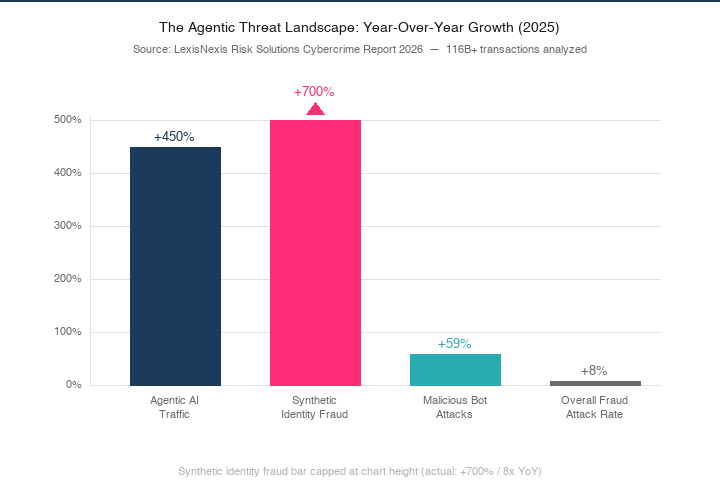
Agentic AI traffic on the global financial transaction network grew 450 percent over the course of 2025, according to LexisNexis Risk Solutions' annual cybercrime report, released this week. The figure, drawn from analysis of more than 116 billion transactions processed through the LexisNexis Digital Identity Network, captures how quickly AI agents have moved from experimentation into live production environments handling real financial activity.
The growth is not evenly distributed across risk categories. Automated bot attacks increased 59 percent year over year, with attackers deploying tools capable of mimicking human cursor movement and login behavior with enough fidelity to defeat behavioral fraud detection systems. Synthetic identity fraud, which assembles fake identities from fragments of real credential data, grew eight-fold and now accounts for more than one in ten confirmed frauds globally.
The report frames agentic traffic as a third category of digital interaction sitting alongside humans and traditional bots: one that fraud detection infrastructure was not designed to evaluate. Unlike traditional bots executing a fixed instruction set, agents operate with dynamic planning, tool invocation, and persistent state, making intent verification a fundamentally harder problem.
The infrastructure gap Jentic is addressing
Into that context, Dublin-based Jentic launched Jentic Mini this week, a free, open-source, self-hosted tool designed to give developers a structured permission layer when connecting AI agents to external APIs. The product targets a specific operational problem: agents need credentials and tool access to do useful work, but granting that access without controls creates exploitable exposure at the identity, execution, and persistence layers of the agent runtime.
Jentic Mini provides access to an AI-curated catalog of more than 10,000 APIs and workflows, with fine-grained permission scoping and a single killswitch to revoke agent data access. The product is built for use with OpenClaw and other general-purpose agent runtimes, and was developed against the backdrop of documented security failures in that ecosystem.
A high-severity vulnerability in OpenClaw (CVE-2026-25253, CVSS 8.8), disclosed in February, demonstrated the problem concretely: an attacker could exfiltrate authentication tokens through a crafted URL, gaining full gateway access and enabling arbitrary command execution. Microsoft's security research team, in guidance published the same month, broke the agent security boundary into three distinct components: identity (which credentials the agent can use), execution (which tools and runtimes it can invoke), and persistence (what state it can modify across sessions). The advisory noted that poor default configurations had left a significant number of self-hosted agent instances publicly accessible without authentication.
Jentic's approach maps directly onto the identity and execution layers of that model. Rather than treating permissions as an afterthought, Jentic Mini enforces them at the point of API access, reducing the blast radius of a compromised agent session.
The broader supply chain risk
The vulnerability surface extends beyond the runtime itself. Security researchers have identified malicious plugins circulating in agent skill marketplaces, designed to deploy infostealer malware and establish persistent system access under the appearance of legitimate agent extensions. Kaspersky identified a targeted campaign in March distributing credential-harvesting malware disguised as installation instructions for popular agent frameworks, including OpenClaw.
The OWASP Top 10 for Agentic Applications, published earlier this year, lists agent goal hijacking, tool misuse, identity and privilege abuse, and memory poisoning as the primary attack surfaces. Memory poisoning is particularly significant in long-running agents: a successful prompt injection can corrupt persistent context, effectively reprogramming an agent to act maliciously across all subsequent sessions.
Jentic Mini is available now via jentic.com and GitHub. The company, which raised $4.5 million in pre-seed funding in late 2024 and was selected for the AWS Generative AI Accelerator, positions the open-source release as infrastructure for a software ecosystem increasingly built to be consumed by agents rather than humans.
Sources: Jentic, LexisNexis Risk Solutions, CybersecAsia, SonicWall
–
By the Control Plane Editorial Team