Mistral AI has secured $830 million in debt financing to build a datacenter outside Paris, its first foray into credit markets and the latest signal that Europe's only frontier-scale AI lab is making a deliberate infrastructure bet rather than racing to match American compute budgets.
The facility, located in Bruyères-le-Châtel south of Paris, will house 13,800 Nvidia GB300 GPUs at 44 megawatts of capacity and is scheduled to become operational in the second quarter of 2026. The transaction was financed by a consortium of seven banks, including Bpifrance, BNP Paribas, Crédit Agricole CIB, HSBC, La Banque Postale, MUFG, and Natixis CIB.
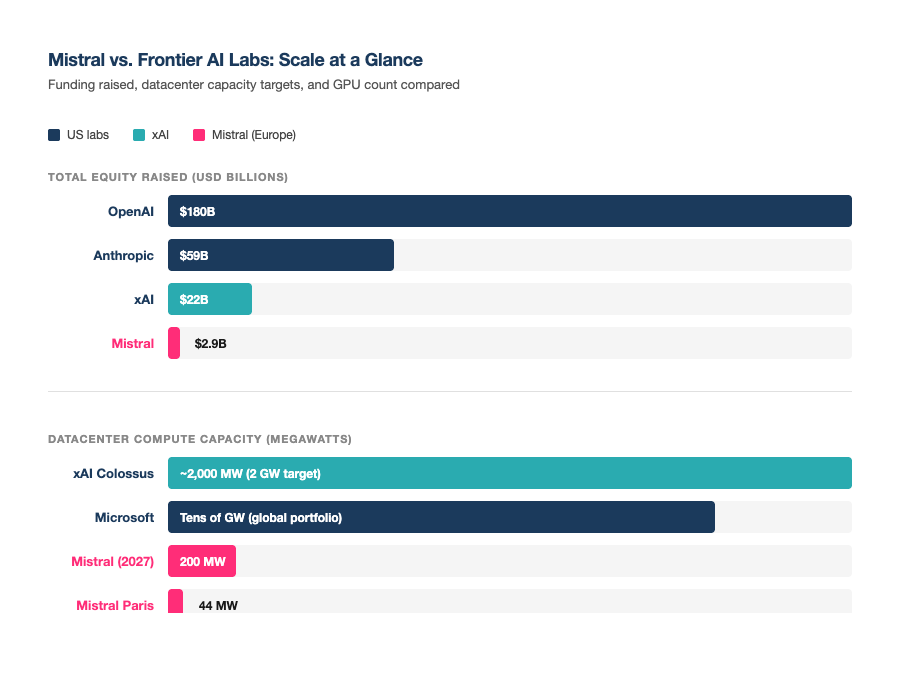
The numbers illustrate how different a game Mistral is playing. OpenAI has raised $180 billion in equity; Anthropic $59 billion; xAI $22 billion. Mistral has raised $2.9 billion in total equity across its lifetime. On compute, the gap is starker: xAI's Colossus cluster in Memphis is targeting 2 gigawatts of capacity, fielding roughly 555,000 GPUs. Mistral's 2027 ambition across all of Europe is 200 megawatts, about ten percent of what one American competitor is building on a single Tennessee site.
That context is not incidental to why Mistral keeps raising money. The company's investment thesis does not require it to out-train GPT-5 or compete on raw compute at hyperscale. It requires something narrower and more durable: that a large, high-margin market exists for AI infrastructure that European governments and enterprises can actually use without routing sensitive data through US-controlled cloud platforms.
CEO Arthur Mensch framed the Paris raise in explicitly geopolitical terms. "Scaling our infrastructure in Europe is critical to empower our customers and to ensure AI innovation and autonomy remain at the heart of Europe," he said. "We will continue to invest in this area, given the surging and sustained demand from governments, enterprises and research institutions seeking to build their own customized AI environment, rather than depend on third-party cloud providers."
That demand is real. GDPR data residency requirements, EU AI Act compliance constraints, and procurement rules for government contracts create friction that US-hosted AI cannot easily resolve regardless of model quality. The Bruyères-le-Châtel site will handle both training and inference, with the inference workload increasingly coming from public-sector customers that need on-shore compute.
The debt structure itself signals a different phase of maturity. Project finance backed by a physical datacenter and contracted revenue is not venture capital; it is a bet by seven institutional lenders on predictable cash flows. Bpifrance, a French state bank, is in that syndicate, which reflects the degree to which the French government has treated Mistral as a national champion since the company's 2023 founding.
The financing follows a February commitment to invest 1.2 billion euros into AI infrastructure in Sweden through EcoDataCenter, with capacity scheduled for 2027. Together, the two projects bring Mistral toward its 200-megawatt European target.
Mistral will not close the compute gap with its US rivals. What it can do is own a market those rivals structurally cannot serve, building a platform credible enough to be acquired at a strategic premium when a hyperscaler decides it needs a European foothold. Microsoft holds both a minority equity stake and an Azure distribution agreement in Mistral. Gulf sovereign funds participated in Mistral's 2025 equity round. The exit path is visible even if the scale race is not.
Sources: CNBC, Reuters, TechCrunch
–
By the Control Plane Editorial Team