Starcloud proved the skeptics wrong on the easy part. Getting a GPU into orbit, running AI inference in space, even training a model on an Nvidia H100 while traveling at 17,000 miles per hour: the Redmond startup reached unicorn status 17 months after its Y Combinator demo day. Its newly announced $170 million Series A at a $1.1 billion valuation — led by Benchmark and EQT Ventures — confirms that investors believe the orbital data center concept has moved from science fiction to credible infrastructure thesis.
The harder problem is not getting to space. It is getting the cost of getting there below $500 per kilogram.
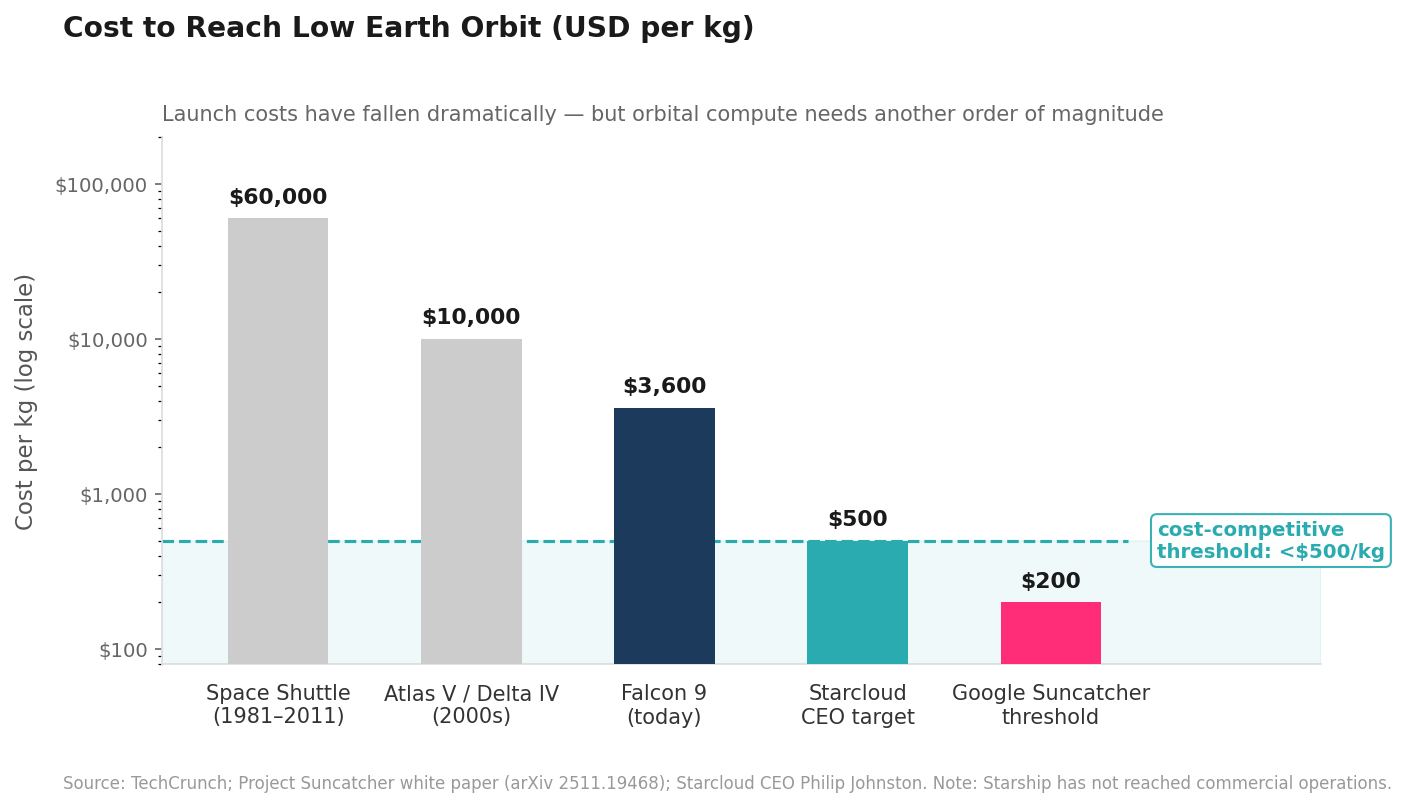
Falcon 9 delivers payloads to low Earth orbit today for roughly $3,600 per kilogram. Starcloud CEO Philip Johnston has said the company’s Starcloud-3 spacecraft, its first designed for commercial cost-competitiveness, needs launch costs around $500 per kilogram to make the economics work — targeting a compute cost of $0.05 per kWh. A learning curve analysis published by Google researchers suggests launch costs to LEO may not reach $200 per kilogram until the mid-2030s. The only vehicle in development that could plausibly get there is Starship, SpaceX’s next-generation heavy-lift rocket, which has not yet reached commercial operations.
“We’re not going to be competitive on energy costs until Starship is flying frequently.”
The demand logic behind orbital compute is genuine. The IEA projects global data center electricity consumption will reach 945 TWh per year by 2030, double the 2024 figure of 415 TWh and roughly equivalent to Japan’s entire national power consumption. Solar irradiance in low Earth orbit runs approximately 1,360 watts per square meter continuously, five to seven times what ground-based solar panels can capture after accounting for cloud cover, atmosphere, and the day-night cycle. At least six U.S. states are considering moratoriums on new data center construction; Dublin’s grid operator has paused new connections until 2028. The terrestrial buildout is running into physical and political walls.
The physics of orbital cooling is more complicated than the marketing suggests. Without atmosphere, convection is impossible. The only mechanism available to dissipate heat in vacuum is thermal radiation, governed by the Stefan-Boltzmann law. Dumping one megawatt of waste heat in orbit requires approximately 1,200 square meters of radiator surface — roughly 35 by 35 meters — held at operating temperature and pointed away from the sun, Earth albedo, and moon simultaneously. Starcloud-2, launching later this year, is engineering what Johnston describes as the largest deployable radiator ever flown on a private satellite. Cooling, not compute, is the payload.
The competitive picture carries its own structural risk. Every orbital compute company’s cost model depends on Starship reaching prices that only SpaceX can deliver. SpaceX acquired xAI earlier this year and has filed regulatory applications to build a constellation of up to one million satellites for distributed AI compute, prioritizing Grok and Tesla Autopilot workloads. The company Starcloud needs to build the bridge to cost-competitiveness is now also the company with the most aggressive plans to become its largest competitor, using that same bridge for its own traffic first.
Johnston is candid about the fallback. If Starship is delayed, Starcloud will keep launching smaller versions on Falcon 9. Full cost-competitiveness is a 2030s story, contingent on a rocket that is not yet flying commercially and manufactured by a company that has publicly prioritized its own compute needs. The orbital data center race is credible. The sequencing risk is structural.
Sources: TechCrunch, EE Times, IEA
–
By the Control Plane Editorial Team